
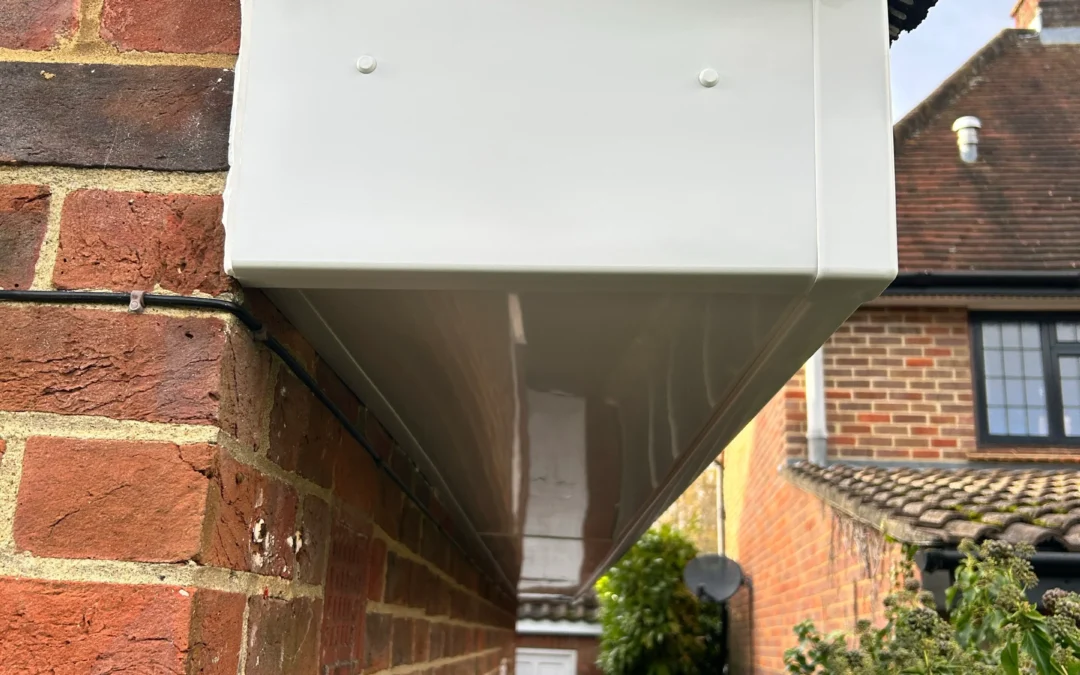
Fascias and soffits don’t get talked about much, but they do a lot of quiet, essential work on every UK home. The fascia is the horizontal board running along the roof’s eaves, fixed directly to the ends of the roof rafters. It’s the board your gutters hang from and the first line of defence against water getting into the roof structure from below. The soffit is the board tucked horizontally beneath the eaves overhang, bridging the gap between the fascia and the outer wall of the building. Together, they seal off the roof space from the elements, provide a clean finished appearance to the roofline, and give the guttering system a solid mounting surface.
When either of them fails, the consequences tend to spread further than most homeowners initially expect, which is why understanding what to look for and what to do about it is worthwhile before a small problem becomes a large one.
What Happens When Fascias and Soffits Fail
A rotting fascia board compromises the fixings that hold your gutters in place almost immediately. Even if the gutters themselves are relatively new and in good condition, they’ll begin to sag and pull away from the wall as the timber beneath them softens and loses the ability to hold the bracket screws. The situation compounds itself. As the gutter pulls away, it begins to overflow or direct water against the fascia rather than into the downpipe, which accelerates the timber deterioration further.
Gaps or holes in the soffit board are a different kind of problem. The soffit seals the underside of the eaves, and when it fails, moisture can enter the roof void and begin to affect the rafter ends and the roof plate timbers. More immediately obvious in practice is the pest access problem. Starlings, sparrows, and squirrels all seek out gaps in soffit boards as entry points to the roof space, and once they’re in, the damage they cause and the difficulty of removing them is significantly greater than addressing the soffit before they arrive. In our experience across South West London’s terraced housing, bird ingress through failing soffits is one of the most common roofline problems homeowners don’t realise they have until it’s already well established.
UPVC: The Modern Standard for Replacement
The material used for almost all new fascia and soffit installations in the UK today is cellular foam UPVC, sometimes called capping board or cellular PVC. It doesn’t rot, doesn’t require painting, expands and contracts with temperature changes without cracking, and has a working life of 25 to 40 years with minimal maintenance. The smooth surface doesn’t harbour moss growth in the same way that painted timber does, and when it eventually reaches the end of its life, replacement is clean and straightforward.
Installation involves either a full strip-out, where the existing timber boards are removed entirely before new UPVC is fixed in their place, or overboarding, where new UPVC is fitted directly over the existing timber boards. The correct approach depends entirely on the condition of the timber underneath, and that assessment needs to happen before a single board goes up rather than being assumed.
The Overboarding Question: When It’s Acceptable and When It Isn’t
Overboarding is quicker and cheaper than a full strip-out, and when the existing timber is structurally sound, it’s a perfectly legitimate installation method. The new UPVC layer provides a clean, maintenance-free surface, and the timber beneath acts as a stable substrate for the fixings. Many properties across South West London have overboarded fascias that have been performing well for 20 years or more with no issues whatsoever.
The problem arises when overboarding is applied to timber that isn’t sound. Soft, damp, or partially rotted timber won’t hold fixings properly, meaning the new fascia will pull away prematurely under the weight of the gutter or after a period of wind loading. Worse, sealing UPVC over damp or partially rotted timber traps the moisture inside and prevents the timber from drying out, which accelerates the rot considerably. Any contractor who recommends overboarding without explicitly confirming the condition of the timber behind it is either cutting a corner or making an assumption. Either way, the risk lands with you when the job fails before its time.
How to Spot Fascia and Soffit Problems Yourself
A reasonable inspection from ground level is possible for most properties. Fascia boards that are visibly warped, cracked, or have patches of peeling paint with bare or darkened timber beneath are showing signs of moisture damage. Soffits with visible cracks, missing sections, or obvious discolouration beneath a persistent damp patch directly above are similarly straightforward to identify from the pavement.
At ladder level, the most reliable test is pressing the fascia board firmly with your fingers near a gutter bracket. Sound timber will feel completely solid. Timber that’s beginning to soften will give slightly under pressure. Timber that’s significantly deteriorated will feel noticeably spongy and will sometimes crumble under moderate pressure. That simple physical test tells you more about the true condition of the board than its surface appearance from the ground ever could.
The Cost of Fascia and Soffit Replacement
Costs vary depending on the size of the property, the material condition, and whether any underlying timber work is needed before the new boards go in. For a typical three-bedroom semi-detached house in South West London, a full UPVC fascia and soffit replacement generally falls between £900 and £2,000, including materials, labour, and waste removal. On larger detached properties or where significant timber repair is needed alongside the boarding work, costs can run to £3,000 or more.
The cost per square metre of the work itself is fairly consistent between contractors on like-for-like quotes. The variation in final prices tends to come from differences in the scope of timber repair included, whether ventilation inserts are fitted to the soffit as part of the job, and how the access is being organised on each specific property.
Why Combining Jobs Makes Financial Sense
The question of whether to combine fascia and soffit replacement with gutter replacement is one that comes up on almost every job we survey where the roofline needs attention. In the vast majority of cases, the answer is yes, and the reasoning is straightforward. The access equipment, the preparation time, and the scaffolding cost are all identical whether you’re doing just the gutters, just the fascia and soffits, or all three together.
If the fascia is being replaced, the gutters need to come off anyway to allow access. At that point, the additional cost of fitting new gutters rather than refitting the old ones is modest. You’re looking at new gutter sections, the fittings, and a small amount of additional labour time. On the other side, fitting new gutters to old fascias when those fascias are already showing early signs of deterioration means you’ll almost certainly be back to repeat the gutter work within five to ten years when the fascia finally fails entirely. Doing everything at once is tidier, more cost-effective, and gives you a roofline you can rely on for the next two to three decades without returning to the same work again.