
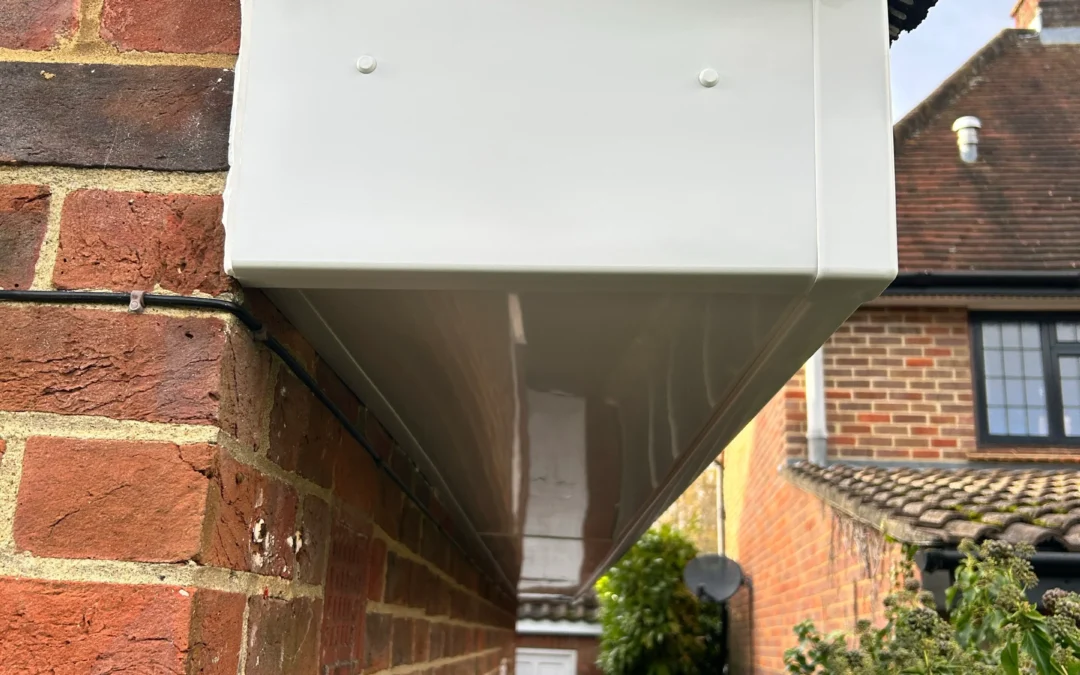
Most people who own a home in the UK have heard the words “fascia” and “soffit” at some point, usually from a builder or a sales rep on the doorstep. But ask the average homeowner to point to them on their house and there’s often a pause. It’s one of those things that sits quietly in the background until something goes wrong, at which point the terminology suddenly becomes very relevant.
We get asked about this a lot, so we thought it was worth putting together a straightforward explanation. No jargon, no technical waffle, just a clear breakdown of what these components are, where they are, and why they matter to you as a homeowner.
Starting from the Top
To find your fascia board, stand back and look at the edge of your roofline. The fascia is the vertical board that runs horizontally along the bottom edge of the roof, just where the roof meets the wall. It sits right behind the guttering, in fact, the guttering is bolted directly into it. This is why the condition of the fascia matters so much; if it’s rotten or crumbling, your guttering simply can’t be properly secured.
The soffit is directly underneath the fascia. It’s the horizontal panel that fills in the gap between the fascia and the wall of your property, closing off the eaves. Think of it as the underside of the roof overhang. From the outside, it’s often the part you have to crane your neck to actually see, which is probably part of why it gets overlooked so often.
What Do They Actually Do?
Together, fascias and soffits form a weatherproof seal around the lower edge of your roof. Without them, the end grain of the roof timbers, the rafter feet, would be exposed to the elements. Wind, rain, and damp would work their way in, and timber exposed in this way deteriorates surprisingly quickly.
The soffit also performs a ventilation function that a lot of homeowners aren’t aware of. Many soffit boards are perforated or fitted with ventilation strips that allow cool, fresh air to enter the loft space. This airflow is essential for preventing condensation from building up in the roof. Without adequate ventilation, moisture trapped in a warm loft has nowhere to go, leading to mould growth and in the worst cases, serious structural rot.
On top of all that, they contribute significantly to how your home looks. A fresh set of clean, well-fitted fascias and soffits can transform the appearance of a tired roofline and improve overall kerb appeal.
What Are They Made From?
The two most common materials you’ll encounter are timber and uPVC. Older properties, anything built before the 1990s, roughly, are likely to have original timber fascias and soffits. These can look great when well maintained, but they require regular painting and sealing to stay in good condition. Once timber starts to absorb moisture, it swells, cracks, and eventually rots, and by the time that’s visible from the ground, the damage underneath is often worse than it first appears.
uPVC has become the material of choice for replacements and new builds alike. It’s essentially maintenance-free, it won’t rot or absorb moisture, and modern versions come in a wide range of colours and finishes, including realistic wood-effect options. We’ve replaced a lot of original timber rooflines over the years, and in virtually every case the customer is relieved they don’t have to think about painting the boards again.
When Should You Be Concerned?
If your home has original timber fascias and soffits, it’s worth doing a visual check at least once a year. Signs to look out for include paint that keeps peeling no matter how recently it was applied (a classic indicator of moisture getting in from behind), boards that look soft, stained, or warped, and gaps appearing at the joints where boards meet. Gutters that are drooping or pulling away from the wall are another red flag, they usually mean the fascia they’re fixed to is no longer solid.
uPVC boards are far less prone to problems, but they’re not completely immune. Cracking can occur over time, particularly if the boards were fitted poorly or if they’ve been exposed to impact. Joints can also work loose, especially on older installations.
If you spot any of these warning signs, it’s worth getting a professional to take a look sooner rather than later. A small issue caught early is almost always far cheaper to address than one that’s been left to develop.
A Word from Our Experience
We’ve been working on rooflines for years, and the number of times we’ve visited a property where the homeowner had no idea their fascias were in trouble until the guttering actually fell off is more than we’d like to admit. One property we visited had original 1970s timber boards that hadn’t been touched since installation. By the time we got there, the rafter feet behind the fascia were so badly rotted that they needed replacing before we could even fit the new boards. What should have been a standard one-day job turned into a three-day repair.
Getting familiar with the basics, knowing what your fascias and soffits are and what to look for genuinely does make a difference. And if you’re not sure about the condition of yours, we’re always happy to offer a free survey and a straight answer.
For more on what we offer, visit our fascias and soffits service page.