
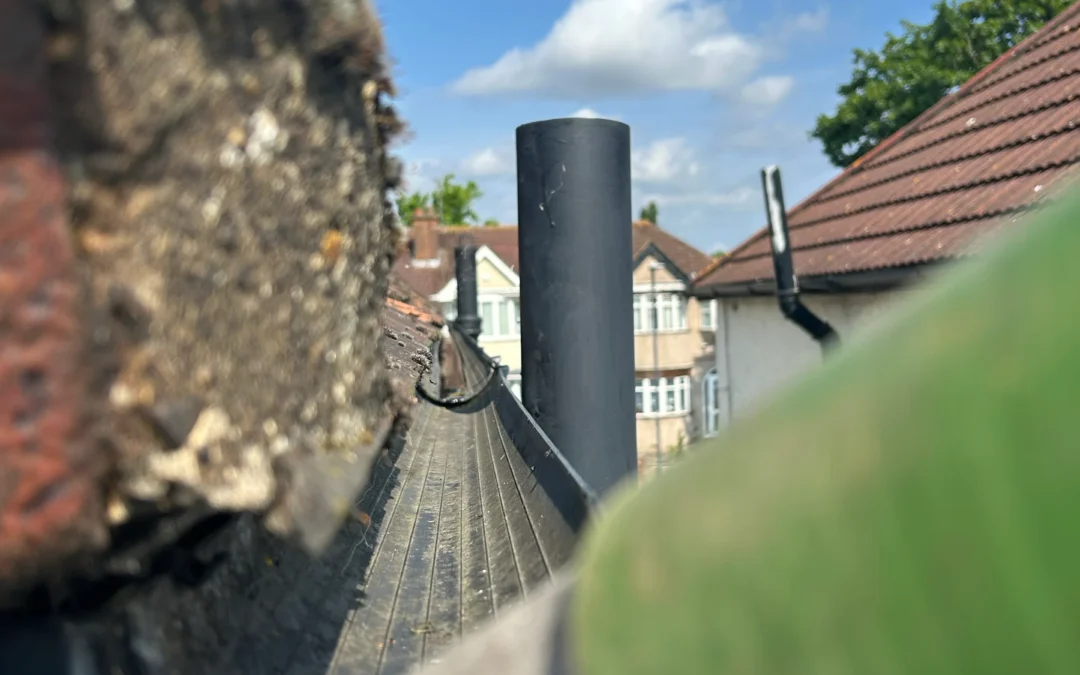
Choosing a guttering material isn’t the most glamorous home improvement decision you’ll ever make, but it’s one that affects how your property looks and performs for potentially the next 30 to 50 years. Getting it right the first time is worth an hour of careful research. Getting it wrong means either living with a system you’re not entirely happy with, or paying to replace it sooner than you should have to.
Why UPVC Is the Default Choice for Most Homes
UPVC is the material most UK homeowners will default to when replacing gutters, and for the vast majority of properties it’s the right call. It’s cost-effective, widely available from dozens of manufacturers, straightforward for any competent guttering contractor to work with, and requires no regular maintenance beyond the cleaning that every system needs. The modern UPVC range goes well beyond the old white systems that dominated domestic rooflines through the 1980s and 1990s. Anthracite grey, black, brown, and cream are all standard colours, and the profiles available cover everything from traditional half-round and ogee shapes to contemporary square-line guttering that suits newer builds extremely well.
In terms of longevity, a well-installed UPVC system will give you 25 to 35 years of reliable service in UK conditions before it begins to show signs of significant age. The joints are the first thing to go, as the rubber seals harden over time, but even that is a manageable repair in the early stages. For the majority of homeowners, UPVC represents excellent value over its working life.
Cast Iron: The Premium Option for Period Properties
Cast iron is the premium option, and it earns its price point in ways that aren’t always immediately obvious. The aesthetic is genuinely different from UPVC, heavier in appearance, sharper-edged, more architecturally considered, and on period properties that difference is immediately visible from the street. A Victorian terrace with well-maintained cast iron guttering has a finished, coherent quality to its roofline that the same property with white UPVC simply doesn’t have.
Beyond appearances, a properly maintained cast iron system is essentially indefinitely durable. The material doesn’t become brittle or degrade with UV exposure the way plastic does. It rusts if neglected, but with regular painting it outlasts everything else on the market by a significant margin. We’ve inspected original cast iron systems in South West London properties that are approaching or exceeding a century in service and are still fundamentally sound, which is something that could never be said of a UPVC system from the same era.
The downsides are real. The initial cost is two to three times higher than UPVC, the installation requires more expertise, and the ongoing maintenance commitment is greater. But for the right property and the right owner, cast iron remains the best long-term investment by some distance.
Aluminium: The Often Overlooked Middle Ground
Aluminium guttering occupies a genuinely useful middle ground that tends to be underrepresented in most discussions of guttering options, largely because it requires specialist forming equipment and fewer contractors offer it as a standard choice. It’s lighter than cast iron but considerably more durable than UPVC, rust-resistant without the weight or maintenance requirements of steel, and available in powder-coated finishes in a wide range of colours that sit very comfortably on both modern and traditional buildings.
The most significant practical advantage of aluminium is the availability of seamless guttering, which are sections formed on-site by a machine that extrudes a continuous run to the exact length required with no joints along the horizontal run at all. Joints are the primary failure point in any guttering system, and eliminating them removes the most common source of leaks. The only joints in a seamless aluminium installation are at the corners and downpipe connections, a fraction of the number in a standard UPVC system on a comparable property.
For a mid-to-large property where the cost difference between UPVC and aluminium can be spread over a significantly longer lifespan, the investment in aluminium is often very reasonable on a cost-per-year-of-service basis.
Profiles and Shapes: What Suits Your Property
Regardless of material, the profile shape of the guttering matters both functionally and aesthetically. Half-round and ogee profiles are the traditional shapes, seen on the majority of Victorian and Edwardian properties and still appropriate for any building with period architectural detailing. Square-line profiles have a more contemporary appearance and have become the standard for newer residential construction and modern extensions.
The profile also determines the flow capacity of the system. Square-line gutters carry more water per linear metre than half-round gutters of the same nominal size, which matters on properties with large or complex roof shapes that shed significant volumes of water in a heavy downpour. On a standard two-storey residential property this rarely becomes a limiting factor, but on a property with a large flat roof section discharging into a single downpipe, it’s worth checking the hydraulic calculations with your contractor.
Specialist Materials Worth Knowing About
Beyond the three main options, there are specialist guttering materials that suit specific contexts. Zinc guttering develops a natural silver-grey patina over time that many architects and conservation specialists find preferable to painted metal. It’s used primarily on high-end restoration projects and new builds where the natural weathered finish complements the architectural intent. Steel guttering, galvanised or powder-coated, offers similar durability to aluminium at a comparable price point and is available in some profiles that aluminium manufacturers don’t currently offer.
At Will Fix It, we work across all the main material types and can advise honestly on what makes most sense for each individual property and set of requirements.
Get expert guttering advice from Will Fix It in South West London