
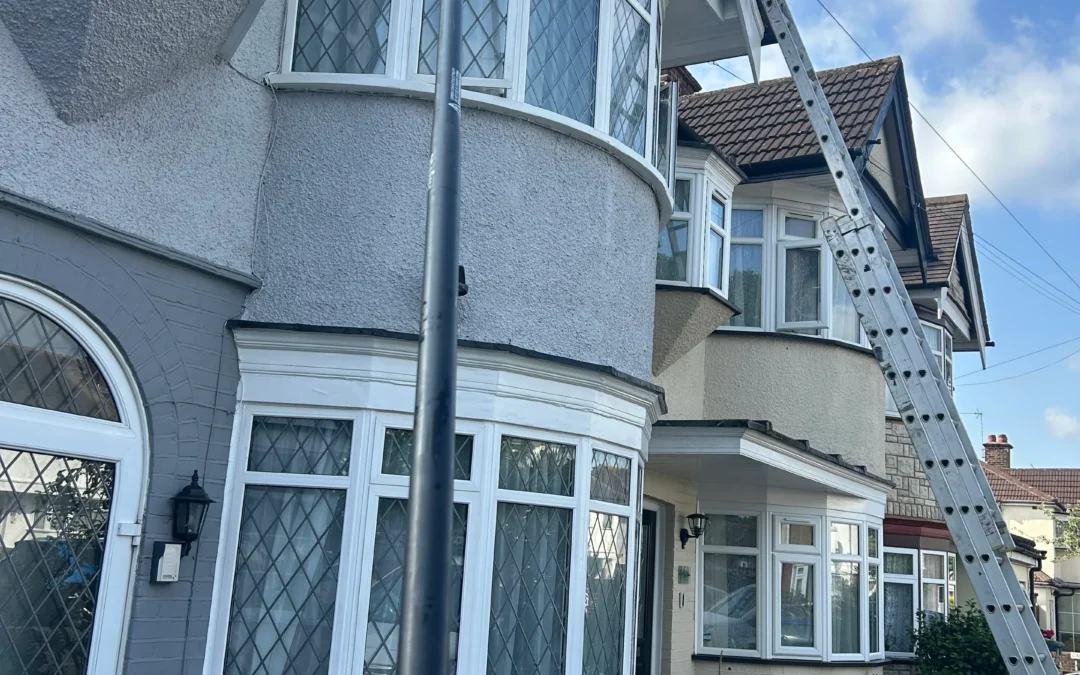
There’s a reason so many roofline jobs are bigger than they need to be by the time we arrive. It’s not that homeowners don’t care about their property, it’s that fascias and soffits are easy to forget about. They sit up there quietly doing their job, and unless you’re specifically looking, it’s entirely possible to miss the early warning signs until the damage has already spread.
The good news is that the signs are usually there well before things reach a critical point. You just have to know what to look for.
1. Paint That Keeps Peeling, No Matter What
If you’ve painted your fascia boards and the paint starts lifting, blistering, or peeling again within a short time, this almost always means moisture is present in the timber. The paint isn’t failing, it’s being pushed off from behind by trapped moisture. Repainting over this again and again doesn’t solve the underlying issue; it just delays the conversation you’ll eventually need to have about replacement.
We’ve visited properties where homeowners had repainted their fascias three times in five years, each time wondering why it wasn’t sticking. In every one of those cases, the boards had significant moisture damage on the reverse side that no amount of exterior paint was going to fix.
2. Soft, Spongy, or Discoloured Timber
Take a thin implement, a screwdriver, for instance, and gently press it against the face of your fascia board (you may need to do this from a ladder or ask someone to check for you safely). Healthy timber should feel firm and solid. If the board gives way, feels spongy, or there’s any visible discolouration, staining, or dark patches in the wood, you’re looking at rot.
Rot in timber fascias spreads. It doesn’t stay confined to one spot, and once it gets into the rafter feet behind the board, the repair becomes considerably more involved. Early detection makes an enormous difference here.
3. Visible Gaps or Separation at the Joints
Fascia and soffit boards are fitted in sections, and the joints between those sections can work loose over time, particularly on older timber installations that have been through many cycles of expanding in the summer heat and contracting in the cold. Any visible gap at a joint is an entry point for water and, depending on the time of year, for wasps, birds, and other unwelcome visitors.
Even on uPVC installations, joints and corners can develop small gaps over time, particularly if the original fitting wasn’t done carefully. It’s worth running your eye along the full length of your roofline once a year to check for this.
4. Gutters Pulling Away from the Wall
Your guttering is fixed directly into the fascia board. If the fascia is rotting from behind, the fixings that hold the guttering in place start to lose their grip. The first sign is often guttering that appears to be sitting at a slight angle rather than running level, or sections that visibly sag between brackets.
Left unaddressed, the guttering eventually pulls away from the property entirely. Beyond the obvious problem of water not being properly managed away from your walls and foundations, this is also a safety hazard, particularly on properties where the guttering passes over a frequently used path or doorway.
5. Damp Patches Inside the Loft or on Upper Walls
If you’re seeing damp patches appearing on your upper walls or inside the loft, particularly where the walls meet the ceiling, it’s worth checking your roofline as one of the potential causes. Water doesn’t always get in through the roof itself; it frequently enters through deteriorating fascias, particularly at the joints or where boards have shrunk and cracked.
The soffit is the other common culprit for damp issues. Cracked or failed soffit boards allow water to track back along the soffit and into the wall, especially when wind drives rain under the eaves. This kind of water ingress can be frustratingly difficult to trace without a proper inspection.
6. Birds, Insects, or Rodents in the Eaves
One of the less obvious signs of soffit deterioration is an increase in wildlife activity around your roof. Starlings, sparrows, and pigeons are particularly fond of nesting in the eaves, and a gap in the soffit is all the invitation they need. Similarly, gaps in the soffit or fascia create entry points for wasps building nests and, in some cases, mice or squirrels looking for a warm spot in autumn.
If you’re hearing scratching or movement from above a ceiling, or noticing a lot of bird activity around a particular section of your roofline, it’s worth getting up and having a careful look at the soffit and fascia in that area.
7. It’s Simply Been a Very Long Time
Sometimes the most honest answer is the most straightforward one. If you’ve bought a property with original 1980s or 1990s timber fascias and soffits, and there’s no record of them ever having been replaced, they’re likely approaching, or past, the end of their useful life. Even if they don’t look dramatically bad from the ground, a closer inspection often tells a different story.
We always recommend getting a professional eye on your roofline when you move into a property, particularly if it’s older or if the records aren’t clear. It’s a small investment of time that can save you a significant amount of money down the line.
If you’ve spotted any of these signs on your own property, don’t put it off. Get in touch with us for a free, no-obligation survey and we’ll give you an honest assessment of what’s needed. You can find out more about our work on our fascias and soffits service page.